Vegetarian, Halal, Allergies & Gluten-Free in China
What to say, what to carry, and which cuisines are naturally safe — written for people who cannot afford a mistake.
First, the structural problem
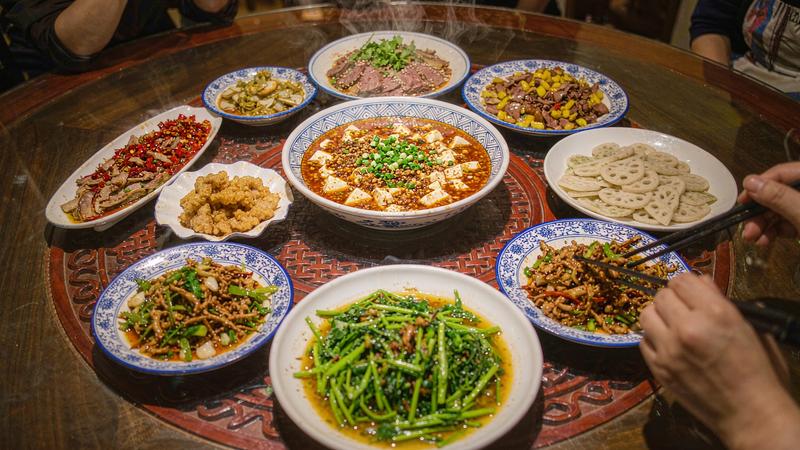
Chinese cooking uses animal products as seasoning rather than as the centre of the plate: lard in a vegetable stir-fry, chicken stock in a “vegetarian” soup, dried shrimp in a dipping sauce. Saying “no meat” is not enough. You need to name the specific ingredients you cannot have, and repeat it at the ordering stage, not after the food arrives.
Vegetarian
It is workable and increasingly easy in cities. Look for 素食 (sùshí, vegetarian) on the sign, or Buddhist restaurants near temples, which are strictly plant-based and often excellent.
- Say: 我吃素,不吃肉、不吃鱼、不吃海鲜、不吃猪油 — “I eat vegetarian: no meat, no fish, no seafood, no lard”
- Ask for 素炒青菜 (vegetable stir-fry) and 豆腐 dishes, and confirm no stock
- Convenience stores, noodle shops and dumpling houses are reliable fallbacks
- In Sichuan, ask for 素麻婆豆腐; the classic version contains minced pork
Halal
China has a large Muslim population and a long-established halal restaurant culture, especially in Xi’an, Lanzhou, Ningxia, Xinjiang and Beijing’s Niujie. Look for 清真 (qīngzhēn) on a green or blue sign, often with Arabic script.
Lanzhou beef noodle shops are everywhere, cheap, fast and reliably halal. In areas without a 清真 sign, assume a kitchen is not halal and plan accordingly.
Allergies
This is the one area where you should not rely on goodwill alone. Peanut oil is common in some regional kitchens, sesame appears in many sauces, and shellfish stock hides in unexpected places.
Carry a printed card in Chinese listing your allergens, and show it before ordering. If the allergy is severe, carry your own medication and eat where you can see the kitchen or where a hotel restaurant can control the process.
Cross-contamination is not a familiar concept in most small kitchens, so “a little is fine” will be taken literally. Be explicit that none is acceptable.
Gluten-free
Harder than vegetarian, because soy sauce contains wheat and is used almost everywhere. Ask for 不放酱油 (no soy sauce) and 不放面酱, and expect a puzzled look.
Naturally safe options: steamed rice, plain rice noodles (米粉, but check they are not wheat-based), fresh vegetables you season yourself, and hotpot with a clear broth. Avoid dumplings, noodles, most fried food and anything with a thick brown sauce.
What to carry
- A printed card in Chinese for each restriction, laminated
- A translation app with camera mode for ingredient lists
- Safe snacks: nuts, dried fruit, plain crackers
- Any medication you might need, in original packaging
The practical tactic that works
Tell your guide or hotel concierge once, clearly, at the start of the trip. They will steer restaurant choices, phone ahead, and explain to the kitchen in a way that a phrasebook cannot. This is the single most effective thing you can do.
Quick answers
Questions travelers ask
Can I survive as a strict vegetarian?+
Yes, especially in cities with Buddhist restaurants and in Jiangnan and Cantonese cuisine. Expect to explain lard and stock every time.
How do I find halal food?+
Look for 清真 on the sign, or head to Lanzhou noodle shops, Xi’an’s Muslim Quarter, Ningxia or Xinjiang. Hotel restaurants are the reliable fallback.
Is it rude to ask for changes to a dish?+
Not at all for allergies or dietary needs; kitchens accommodate requests routinely. Just be clear and specific rather than apologetic.